Author: Joy

  • Hugs outside the home

    Some of us are fortunate enough to be surrounded by people who casually hug us with love and affection on a regular basis – but not everyone has that privilege. Long before I became a platonic touch therapist, I was an enthusiastic participant in informal ‘free hug’ events at train stations in various Dutch cities.

    These events seek to promote ‘random acts of kindness’ (a phrase attributed to Anne Herbert). Small groups of volunteers head out to public areas and offer hugs and a listening ear to the people passing by.

    In my own personal experience, quite of few of those who were willing to accept a hug from a complete stranger reported that it was their first hug that week. One man I’ll never forget told me that no one had hugged him since his mother’s funeral, two months before.

    NOCA banner, Free Mom Hugshttps://freemomhugs.org/

    At Pride parades across Europe and North America, free hugs also are offered by supportive allies and members of the LGBTQ+ community. Although there’s no way these volunteer hugs can fully replace acceptance from friends and family, they do try to represent a level of welcome that is sadly lacking in other contexts.

  • Benefits of touch

    The therapeutic benefits of touch have been well documented. Various studies over the past few decades confirm that physical touch is vital to our health and well-being – and everyone remembers feeling touch-starved during the worst of the pandemic lockdowns.

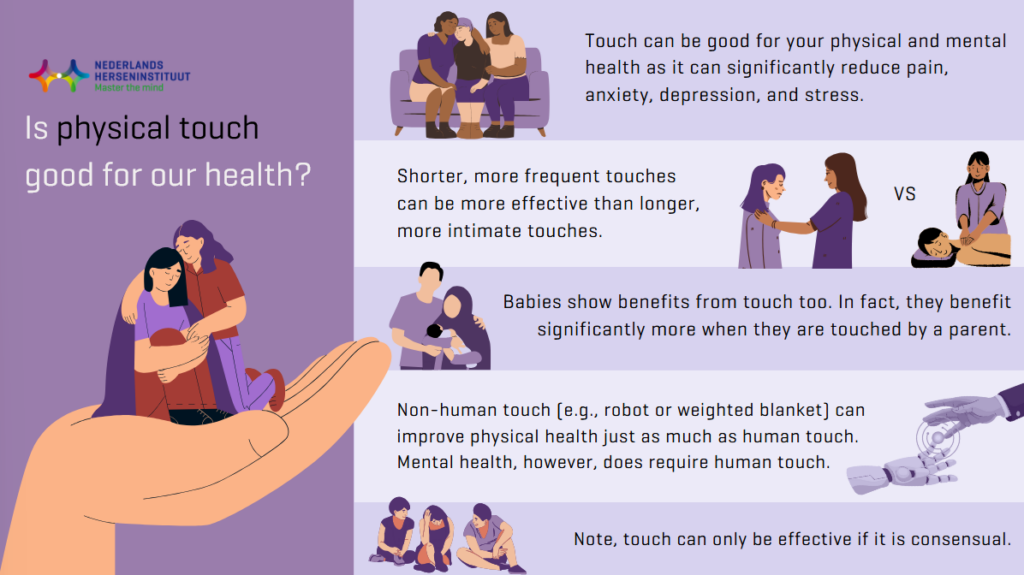
    A 2024 study by the Netherlands Institute for Neuroscience aggregated results from other research, offering a clear answer:

    Yes, touch substantially improves both physical and mental wellbeing, for example via reduction of pain, anxiety, depression, and stress in adults. […] Those with physical or mental health problems (and therefore most in need of support) benefit even more from touch than healthy adults.

    Infographic: Is physical touch good for our health?
    Infographic from news release, Netherlands Institute for NeuroScience
  • What is platonic touch therapy?

    Platonic touch therapy is a well-established concept in some circles, but it’s relatively new to the general public. If you search online, there are a few practitioners scattered across the Netherlands, often offering their services as ‘cuddle therapy’, ‘therapeutic hugging’ or ‘holistic touch’.

    However, the people doing the best work in this field seem to get most of their referrals through word-of-mouth – simply because our clientele doesn’t always have the words they need to search for our services.

    The short version:

    Semi-structured, consensual, comforting physical contact in a non-sexual context.

    Tamara Hill wrote in 2018:

    Mental health professionals are often the first line of contact for someone in crisis. Therapists must “bring along” a host of tools to assist the person in crisis and bring them back to a place of balance and equilibrium. But […] some tools simply don’t work. No philosophical jargon, no breathing technique, no reverse psychology, no cognitive restructuring, no challenging of inaccurate thoughts, no co-regulation of emotions, no validation, etc. can take the place of a firm therapist-client relationship and the tool of touch.

    Platonic touch therapy is not an alternative to traditional medicine or psychology – but it can complement them.